

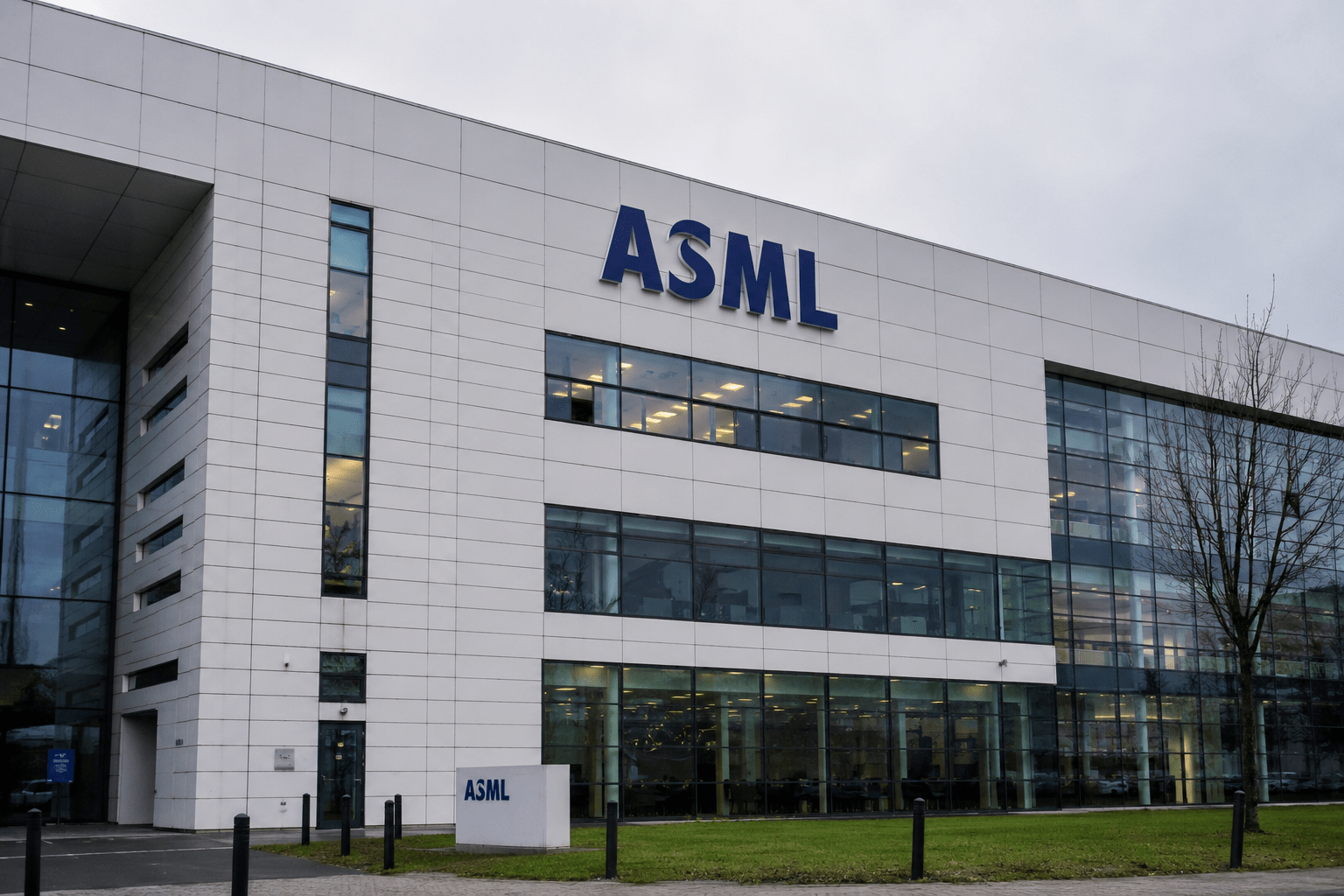
ASML Holding raised its financial guidance for 2026 on Wednesday after reporting stronger-than-expected second-quarter earnings and announcing plans to increase capacity.
The results showed that robust demand for artificial intelligence chips continues to fuel investment across the semiconductor industry.
The Dutch company, the world’s largest supplier of semiconductor manufacturing equipment, now expects full-year 2026 net revenue of between €43 billion and €45 billion, representing a 16% increase at the midpoint from its previous forecast range of €36 billion to €40 billion.
The upbeat guidance sent ASML shares more than 5% higher in Amsterdam, while its US-listed shares climbed about 3.5% in premarket trading.
The company also issued stronger-than-expected guidance for the current quarter, forecasting third-quarter revenue of €11.5 billion, well above analysts’ consensus estimate of €10.37 billion.
It expects a gross margin of 56%, compared with market expectations of 52.1%.
Earnings beat estimates
Revenue for the three months ended June 30 rose to €9.33 billion ($10.9 billion), comfortably ahead of analysts’ estimates of €8.8 billion compiled by LSEG.
Net income came in at €2.92 billion, also exceeding expectations of €2.62 billion.
The results were closely watched after recent sell-offs across technology stocks amid concerns that the AI investment cycle could be losing momentum.
Instead, ASML reported what Chief Executive Christophe Fouquet described as “extremely strong” order intake, underpinned by continued spending on AI infrastructure.
“Ongoing AI-related investments and continued progress in AI technologies are driving demand for advanced Logic and Memory chips, further strengthening the semiconductor industry’s growth outlook,” Fouquet said in a statement.
“Our customers, in turn, continue to accelerate their capacity expansion plans, providing ASML with increased visibility into longer-term demand.”
Chipmakers continue expanding capacity
ASML remains the world’s sole manufacturer of extreme ultraviolet (EUV) lithography systems, which are essential for producing cutting-edge semiconductors used in AI processors.
Customers, including Taiwan Semiconductor Manufacturing Co. (TSMC), Samsung Electronics, SK Hynix, and Micron Technology, are investing heavily to expand production capacity as demand for AI chips continues to rise.
The company said it plans to increase production capacity for both its flagship EUV systems and deep ultraviolet (DUV) tools by about 30% in each of the next two years.
While EUV machines are used to manufacture the most advanced chips, DUV systems continue to see strong demand for mature-node production, including in China.
Separately, Fouquet said Intel will use ASML’s latest High-NA EUV system to manufacture some of its most advanced Panther Lake processors, marking the first commercial deployment of the technology.
Analysts remain optimistic
Analysts said the earnings underscored that AI-driven investment remains firmly intact.
“The biggest surprise came from customers upgrading and servicing equipment already on factory floors, a sign that chipmakers are pushing existing capacity while preparing for the next wave of investment,” said Matt Britzman, senior equity analyst at Hargreaves Lansdown.
“But this is more than a short-term scramble. AI demand is pulling investment forward across both advanced computing and memory chips, giving ASML clearer sight of customer demand well beyond this year.”
Britzman added that the debate has now shifted from demand to manufacturing capacity.
“The story has now shifted from whether demand will arrive to whether ASML can expand production fast enough to meet it. Management is responding with ambitious capacity plans, directly addressing one of the main concerns that has been rumbling in the background.”
“That supports our view that ASML remains one of the clearest ways to gain exposure to the AI infrastructure build-out, thanks to technology that the world’s leading chipmakers simply cannot replace. ASML now needs to convert a powerful order pipeline into system deliveries, revenue, and profit – scaling production without losing control of costs.”
Bank of America reiterated its Buy rating and €2,022 price target on the stock following the results, Investing.com reported, a 14% upside to Wednesday’s levels.
According to the brokerage, ASML’s updated guidance implies fourth-quarter revenue of €14.41 billion, significantly above the consensus estimate of €11.62 billion, with gross margins also expected to exceed market forecasts.
ASML shares have gained about 66% in Amsterdam this year and more than 52% in US trading, reflecting growing investor confidence that the company remains one of the biggest beneficiaries of the global AI infrastructure buildout.
The post ASML stock jumps after 2026 outlook raise as AI demand drives capacity expansion appeared first on Invezz